
Key themes shaping growth, investment and consolidation across the UK defence technology sector.
Article
The UK Defence Investment Plan: A catalyst for growth and investment in the technology and technology services sector
Published:
19 October 2026
Share
Written by:




The publication of the Defence Investment Plan (DIP) on 30 June 2026 provides much needed certainty and visibility for the sector, with £298 billion of confirmed investment to 2030.
Technology is a central tenet of the DIP, with material commitments to AI, cyber security, secure digital infrastructure, data connectivity and autonomous systems. We believe these priorities should create opportunities across the technology supply chain, particularly for businesses providing systems integration, software engineering, data and AI services, cyber security and managed security solutions.

Greater budget visibility will likely enable some procurement activity that was delayed during the policy review period to now progress. In turn, this will create a more supportive backdrop for specialist technology and service providers, opening the significant addressable market.
SMEs should also benefit from a renewed emphasis on their role in the supply chain. The MOD’s latest published Action Plan targets £7.5 billion of annual direct and indirect expenditure with SMEs by 2028, representing a stated 50% increase on the current position. Measures intended to support this ambition include simplified procurement processes, the ‘Defence Office for Small Business Growth’ and requirements for prime contractors to provide improved visibility of subcontracting opportunities.
Recent investment activity suggests that private capital is becoming increasingly receptive to specialist defence technology and technology services businesses, particularly where companies combine strong technical differentiation with visible government-backed demand. However, we also expect greater bifurcation in the ecosystem – the most attractive and successful businesses are those that can demonstrate the quality of their earnings, revenue visibility, technical capability and strength of customer relationships.
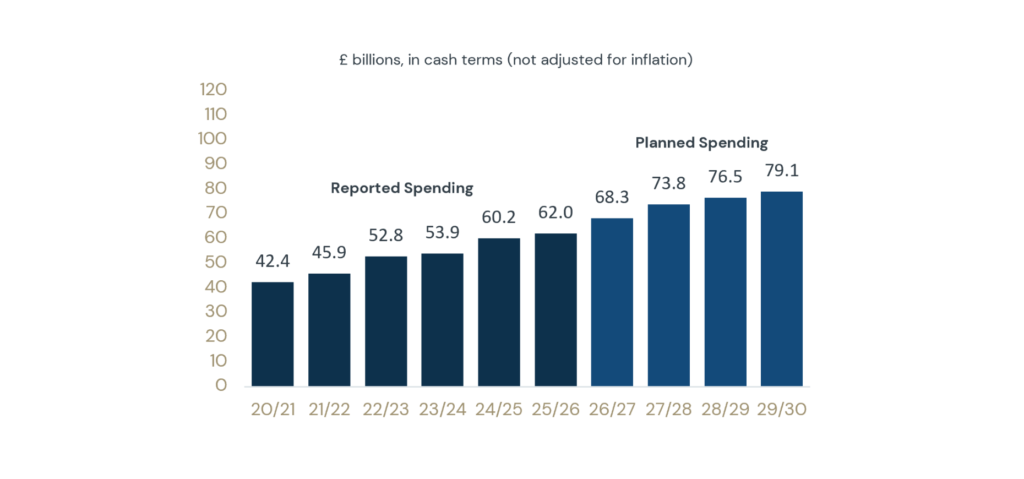
Key technology investment themes from DIP
Data, AI, cyber and digital transformation sit at the heart of the UK’s defence modernisation agenda. Several major commitments illustrate both the scale of investment and the direction in which defence capability is moving. These include:
- Autonomous systems: £5 billion will be invested to deliver unmanned delivery systems
- Digital Targeting Web: Nearly £2 billion will be funnelled into connectivity and data
- Digital Backbone: As part of the broader Digital Backbone agenda, a further £5.5 billion will help to put in place the Armed Forces’ core digital infrastructure
- Cyber security: Cyber investments will also be ramped up to the tune of £2.5 billion to support the Defence Cyber and Electromagnetic Force and wider cyber capabilities
Defence-focused tech firms poised for growth
The DIP signals that defence investment is a long-term priority and, crucially, provides visibility over future spend. Alongside the broader emphasis on sovereign AI capabilities, this is expected to increase demand for UK-based AI, cyber and digital technology providers, creating opportunities for firms that can support the adoption and deployment of advanced defence technologies.
Consultancies and MSPs
While procurement efficiency will focus in part on reducing reliance on external consultancies, we still expect consultancies to play a critical role in delivering the Strategic Defence Review’s (SDR) vision.
- Systems integration will be crucial to deliver the connectivity and real-time data processing required as part of the Digital Targeting Web & Digital Backbone programmes
- Data & AI specialists will be needed that can accelerate AI adoption and deployment
- Cyber consultancies will play a key role in helping to build the “world-leading cyber intelligence capabilities” set out in the DIP. Meanwhile, managed security service providers (MSSP) will deliver the assurance of managed detection and response
Software Firms
Likewise, significant revenue opportunities exist for software firms, as advanced AI and cyber capabilities become increasingly software defined.
- Drone transformation and hybrid warfare will require large-scale investment in AI and autonomous technologies
- AI and data capabilities will sit behind DTW & Digital Backbone, acting as a software layer connecting systems
- Cyber security software vendors stand to benefit from the substantial investment into advanced cyber platforms across AI-enabled threat detection & response to build digital resilience
Which technology businesses will attract buyers and investors?
The DIP may expand the addressable market but exposure to increasing defence expenditure will not, by itself, create a premium asset. Buyers and investors are unlikely to value all businesses equally. In our view, the characteristics most likely to support strategic interest and stronger valuation outcomes include:
- Long-term contracted revenue visibility, supported by repeat awards, renewals and expanding customer relationships
- Proprietary or market-accepted IP, rather than dependence on commoditised delivery capacity
- Technical capabilities that are difficult to replicate
- Senior customer relationships across Armed Forces divisions and embedded positions within strategically important programmes
- Appropriately security-cleared personnel and high standards of security, compliance, governance and operational resilience
- Specialist domain expertise, with manageable customer and/or programme concentration or a credible route to diversification
- Scalable delivery models where growth is not entirely dependent on additional headcount
Direct customer relationships are typically attractive to investors because they provide service providers with greater influence over contract economics, renewal discussions and programme visibility. However, subcontracting through a prime contractor is not inherently less valuable. A specialist service provider can remain highly attractive where its capability is mission-critical, difficult to replace and embedded across multiple programmes or prime contractor relationships.
The businesses best positioned to attract investment are those that can combine specialist technical capabilities with defensible IP, embedded customer relationships and long-term revenue visibility. Direct contract awards may strengthen the investment case, but specialist subcontractors can be equally attractive where their capabilities are critical, differentiated and difficult to replace.
For founders and shareholders, the focus should be more than just demonstrating exposure to a growing market. The strongest businesses will be those able to evidence the quality, scalability and defensibility of that exposure. This means translating technical credentials into a clear investment case, demonstrating recurring or contracted revenues, repeat customer demand, differentiated capabilities, embedded relationships and the potential to scale without a corresponding increase in headcount.
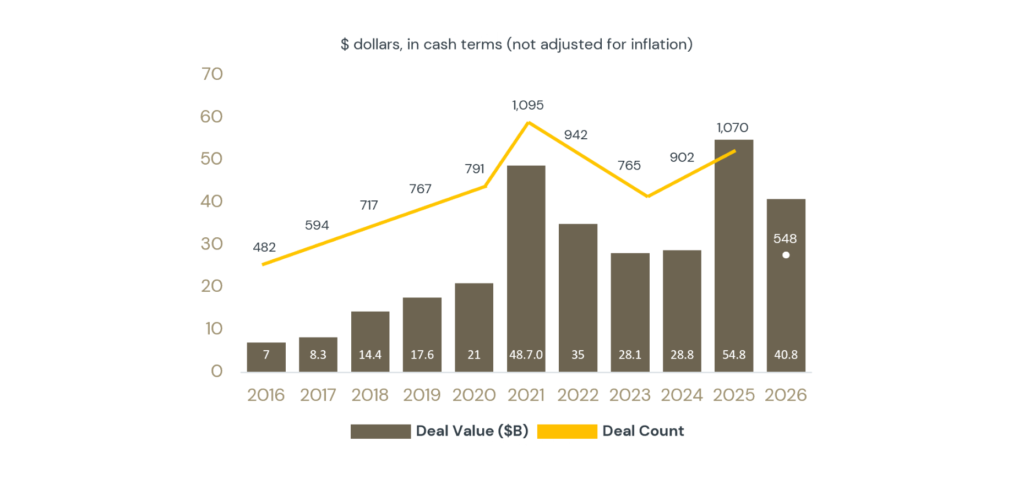
Recent investment and consolidation activity includes:
- IBM’s acquisition of UK cyber security consultancy Logiq Consulting, strengthening its secure digital transformation and cyber security capabilities across defence and other highly regulated sectors (September 2026)
- UK-based maritime defence technology company and manufacturer Kraken Technology Group raised $175 million, closing its Series B funding round (July 2026)
- Phoenix Equity Partners’ investment into defence specialist procurement and data consultancy Squarcle (July 2026)
- US-based defence specialist technology firm Booz Allen Hamilton’s acquisition of UK-based mission-critical software and encryption product provider Ultra Mission for $720 million (August 2026)
- Phoenix Equity-backed cyber consultancy Logiq acquired UK-based software development and technical consulting services for secure environments Savient (April 2026)
- Listed Italian aerospace and defence giant Leonardo announced the acquisition of UK-based disk encryption specialist and MSSP BeCrypt (March 2026)
Future investment outlook
As defence spending shifts towards technology-enabled capabilities, greater budget visibility, increased SME participation and sustained investment in AI, cyber and digital infrastructure should create a more supportive environment for growth, investment and consolidation among the strongest UK defence-focused technology businesses.
Macro geopolitical trends are creating demand for nations to re-focus on defence and critical national infrastructure, with decade long procurement planning already underway. For owners, management teams and investors, we believe this could mark the beginning of a golden age for UK tech and services businesses operating within the defence ecosystem.
(¹) https://researchbriefings.files.parliament.uk/documents/CBP-8175/CBP-8175.pdf
Greater budget visibility, increased SME participation and sustained investment in AI, cyber and digital infrastructure should create a more supportive environment for growth, investment and consolidation.
The businesses best positioned to attract investment are those that can combine specialist technical capabilities with defensible IP, embedded customer relationships and long-term revenue visibility.
For owners, management teams and investors, we believe this could mark the beginning of a golden age for UK tech and services businesses operating within the defence ecosystem.

Video
What is fuelling acquisition interest in fragrance?
Why niche fragrance, wellbeing-led brands and sustained success are attracting investor interest.

News
FRP Advisory appoints Dougal Baxter as Partner to grow Midlands Transaction Services offering
FRP Advisory has appointed experienced deals adviser Dougal Baxter as Partner as it expands its Transaction Services (TS) offering across the Midlands.
/Passle/MediaLibrary/Images/2026-09-18-10-40-51-074-6aad15335f15d498f767adcc.jpg)
Quick read
Retail’s message to the Chancellor – cut costs, create certainty
Retailers need targeted action from the Autumn Budget on employment costs, business rates and policy certainty to unlock investment in…

News
FRP Corporate Finance strengthens travel and hospitality expertise with new partner
FRP Corporate Finance has appointed Mark Stoddart as Partner to lead its activity within the travel, leisure and hospitality sectors.

Article
Mid-market M&A gathers pace as buyer confidence returns
Peter Aspinall reviews the latest developments in the M&A market.