



Financial Services leaders and advisers gathered at the London Stock Exchange to explore how businesses can pursue growth while responding to economic uncertainty, regulatory change and emerging technology.
Article
2026 Financial Services Symposium: Building confidence in a changing market
Published:
29 September 2026
Share
Written by:


FRP’s 2026 Financial Services Symposium
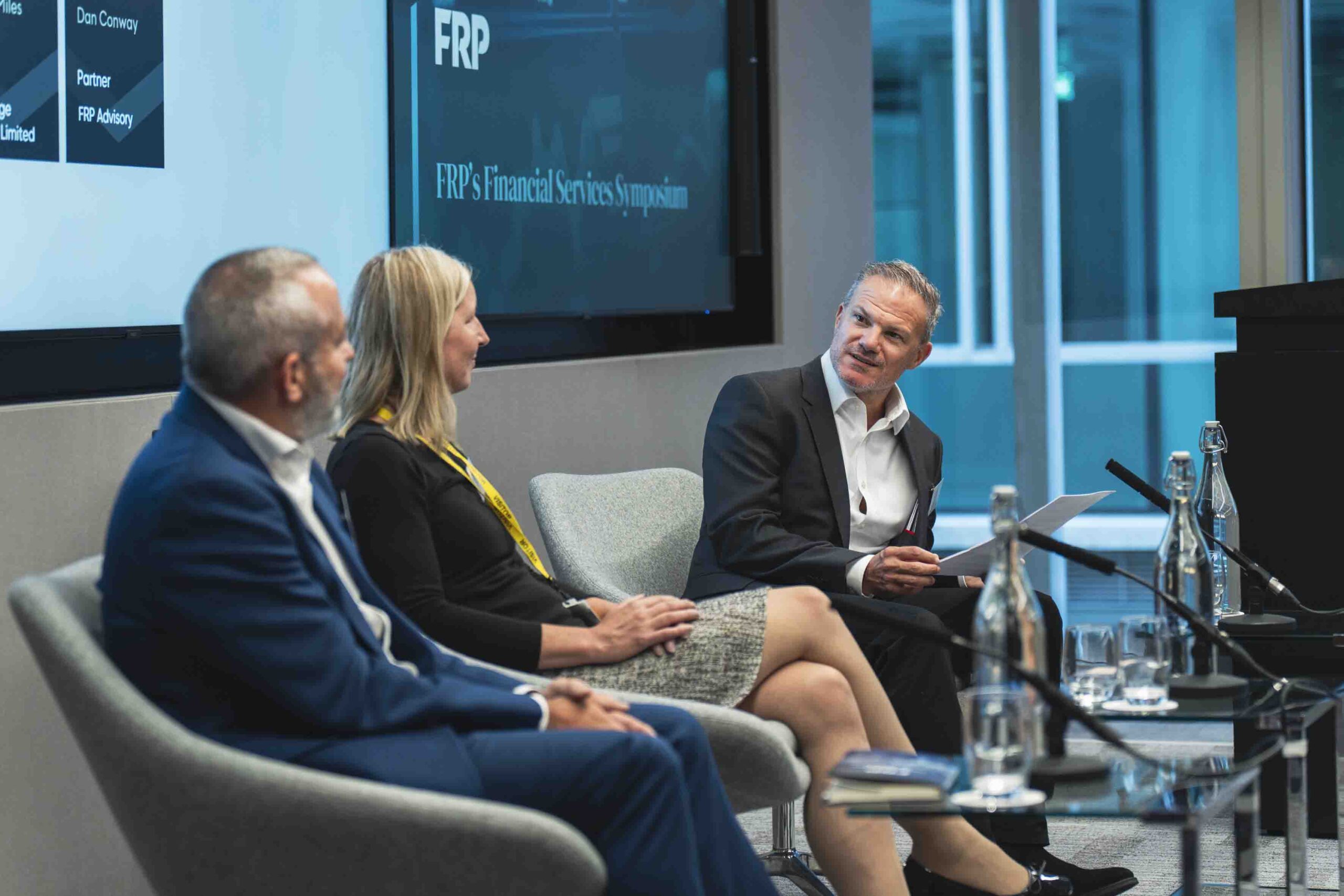
Financial Services leaders and advisers gathered at the London Stock Exchange to explore how businesses can pursue growth while responding to economic uncertainty, regulatory change and emerging technology.
The symposium opened with a keynote from Marcus Stuttard, Head of AIM & UK Primary Markets at London Stock Exchange, and FRP’s market perspectives, drawing on its Decision Economy research and insights from specialists across the firm. This set the context for two panel discussions exploring the economic outlook, access to capital, regulatory change and the role of technology in supporting sustainable growth. Across the sessions, a consistent message emerged: resilient firms will be those able to create clarity, make confident decisions and adapt while maintaining strong fundamentals.
FRP market perspectives: Deciding with confidence
Opening the symposium, Holly Holgate, Restructuring Partner at FRP, examined how uncertainty, regulation and technological change are affecting decision-making across financial services. Drawing on insights from FRP’s Decision Economy research and specialists across the firm, she highlighted forum key themes:
- Mid-market decision-making is becoming more difficult. 85% of financial services leaders said it had become more difficult since the last General Election, and only 32% believed decisions were being made at the optimal speed.
- Speed creates value. Leaders estimated that faster decisions could deliver a 10% uplift in revenue growth, while 73% said they could improve profit margins.
- Delay reduces options. Information overload, time pressure and cost pressures can slow action, increasing risk and limiting flexibility.
- AI is adding new challenges: Attention has shifted from whether to invest in AI to how it can be implemented effectively, while managing governance, accountability, data security and uncertain returns.
Panel 1: Capital, confidence and resilience
Marita Cavalcanti, CFO at Bound, and Derek Miles, Co-Founder and CEO of Nine Edge Wealth Limited, joined Dan Conway, Restructuring Partner at FRP, to discuss the economic and industry outlook, investor expectations and the practical challenges of scaling a financial services business.
Growth opportunity remains, but firms must be selective
Despite economic uncertainty, panellists agreed that opportunities remain available for well-positioned businesses.
- Foreign exchange volatility continues to create commercial opportunities, even as higher interest rates and geopolitical uncertainty affect confidence.
- While funding volumes declined during 2025, capital remains available in the UK market.
- In wealth management, tax changes are creating opportunities for firms able to respond quickly to shifting client needs.
- Technology and AI can improve access to markets and support more consistent customer service when implemented thoughtfully.
Data is central to investor confidence
- Investors increasingly expect clean, accurate and readily available data. Real-time information supports reporting, operational efficiency and better-informed decisions.
- For growing businesses, establishing strong data disciplines early can avoid the complexity of correcting fragmented systems later.
Growth increases the importance of culture and control
- As a business scales, leaders can become further removed from customers and employees. A clearly defined culture, aligned people and a strong leadership team help maintain control.
- M&A can accelerate growth but may introduce historical liabilities and integration risks. Thorough diligence and early planning are essential.
- Successful firms will recruit and develop people who can adapt as technology and customer expectations evolve, including by upskilling candidates with transferable capabilities rather than relying only on traditional profiles.
Preparation and early advice strengthen resilience
- Robust contingency and wind-down planning can help firms respond to unexpected economic or operational change.
- External advisers can add value across M&A, people strategy and technology implementation, particularly when engaged early and focused on achieving clear outcomes.
Panel 2: Growing with confidence and balancing risk
Emad Aladhal, Director at the FCA; Kate Robinson, Principal at Avyse Partners; and James Alleyne, Partner at Kingsley Napley, joined Holly Holgate to explore how firms can innovate and grow while maintaining effective consumer protection, governance and regulatory trust.
A more predictable, outcomes-focused regulator
Panellists discussed the FCA’s evolving approach to regulation and supervision.
- The regulator’s strategy focuses on supporting growth and innovation, helping consumers and tackling financial crime.
- Businesses can focus on defining, evidencing and monitoring positive customer outcomes.
- Regulatory divergence across the UK, US and EU continues to add complexity for firms looking to scale internationally.
Governance should enable growth
A recurring theme was that governance is most effective when it supports decision-making rather than creating unnecessary process.
- Accountability, oversight and record-keeping remain essential, particularly as new technologies are adopted.
- Effective governance should focus on achieving outcomes rather than increasing bureaucracy.
- Open, proactive engagement with the regulator can help businesses resolve issues more effectively and build trust.
AI requires clear ownership and effective challenge
While AI presents significant opportunities, firms must maintain appropriate oversight.
- AI-generated outputs create legal, confidentiality and accuracy risks.
- Senior ownership, employee training and robust processes are essential.
- Although the technology is new, the underlying principles remain the same: effective oversight, accountability and protection of customer outcomes and market integrity.
Consumer Duty must shape the business model
The panel emphasised that Consumer Duty should be integrated into strategic decision-making.
- Positive customer outcomes need to be demonstrated through evidence and analytics.
- The Duty should shape business models, not simply operational processes.
- Regulators recognise that implementation challenges occur, but expect transparency and genuine commitment to improvement.
What should Financial Services firms focus on next?
The panel identified six priorities for businesses looking to grow while navigating uncertainty, regulatory change and technological disruption:
- Create decision clarity by defining ownership, improving access to reliable information and acting with greater confidence and speed.
- Strengthen data foundations so leaders, investors and regulators can rely on accurate, accessible and decision-ready information.
- Build resilience into operations through robust contingency planning, operational resilience frameworks and regular testing of critical supplier and technology dependencies.
- Make governance an enabler of growth by maintaining clear accountability and effective oversight without creating unnecessary process or bureaucracy.
- Adopt AI responsibly by establishing clear business objectives, senior ownership and appropriate safeguards to ensure outputs remain accurate, transparent and accountable.
- Seek advice early and engage openly with advisers and regulators to address challenges before options become more limited.
Building confidence through strong fundamentals
The symposium reinforced that growth and resilience are not competing priorities. The businesses best positioned to succeed will be those that combine timely decision-making with reliable data, effective governance and the ability to adapt. In an environment defined by economic uncertainty, regulatory change and technological disruption, those fundamentals will help firms preserve options, respond earlier to emerging challenges and pursue sustainable growth with confidence
Insights
Explore our Insights, Articles & Podcasts.
View all our insights.

Article
This is no longer one recovery

Article
The UK Defence Investment Plan: A catalyst for growth and investment in the technology and technology services sector
Key themes shaping growth, investment and consolidation across the UK defence technology sector.

Quick read
Diesel is no longer just a cost assumption

Newsletter
Transition Newsletter – Edition 5

Video
What is fuelling acquisition interest in fragrance?
Why niche fragrance, wellbeing-led brands and sustained success are attracting investor interest.