





Business leaders are making decisions in an environment defined by uncertainty. Economic pressures, rapid technological change, evolving customer expectations and competing stakeholder demands mean there is rarely a perfect answer – only the need to act.
That was the focus of FRP’s recent Decision Economy breakfast event in London, where business leaders, investors and advisers came together at the 12th Knot Sea Containers, to explore one of the findings from FRP’s latest research: could faster decision-making unlock £13.7 billion of additional value across the UK mid-market each year?
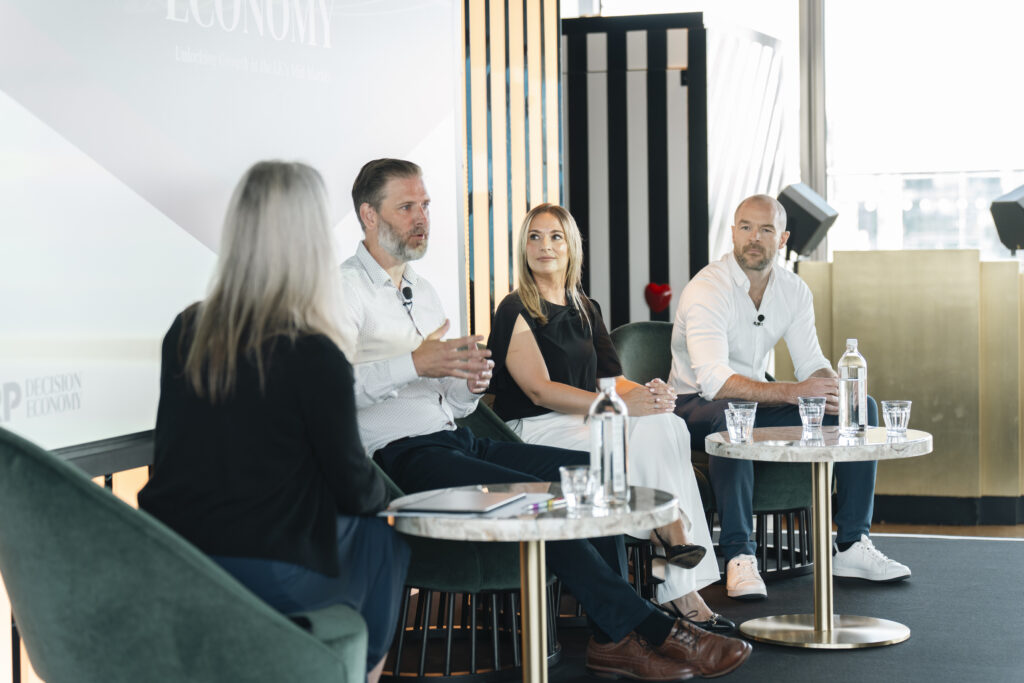
Held under Chatham House Rule, the discussion was shaped by a panel bringing together different perspectives on decision-making: FRP’s Angie Boothroyd and Jim Davies were joined by Laura Phelps-Naqvi, Partner at Kiddy & Partners and Chartered Occupational Psychologist, who focused on leadership behaviour and organisational capability; and Alun Tribe CEO at IMIG who brought expertise in entrepreneurial, owner-manager decision-making and growth choices. Together, they examined what sits behind decision delays and how organisations can build the confidence to act more effectively.
Decision drag is rarely just a leadership problem
One theme emerged early in the discussion: delayed decisions are often a symptom of deeper organisational issues.
While leadership is critical, businesses that struggle to make timely decisions frequently face challenges around structure, accountability, culture and clarity of purpose. As organisations grow, the decision-making models that worked during the startup phase can become increasingly ineffective. Informal conversations and founder-led judgement often need to evolve into clearer governance frameworks, delegated authority structures and defined responsibilities.
The conversation echoed a broader finding from FRP’s Decision Economy research: decision quality and decision speed are closely linked to organisational clarity. Businesses that understand their priorities and empower people to act are often better positioned to seize opportunities when they arise.

Growth can create complexity
The panel explored how growth can contribute to the challenge of recognising opportunities quickly but taking longer to act on them. As organisations scale, decision-making naturally involves more stakeholders, more data and more operational complexity. Teams that were once able to act quickly can find themselves navigating additional reporting lines, governance requirements and competing priorities.
Rather than viewing this as an unavoidable consequence of growth, attendees discussed the importance of establishing clear ownership and accountability. Defining who is empowered to make which decisions can significantly reduce friction and help organisations maintain momentum as they expand.
Healthy challenge drives better outcomes
Another recurring theme was the role of debate in effective decision-making.
High-performing leadership teams are not necessarily those that agree on everything. Instead, they create environments where differing views can be aired constructively before a decision is reached.
The discussion highlighted the importance of psychological safety – ensuring people feel comfortable challenging assumptions, raising concerns and offering alternative perspectives. Without this, businesses can fall into the trap of “false harmony”, where apparent agreement masks unresolved issues that later undermine execution.
For leaders, the challenge is balancing robust debate with a commitment to collective action. Once a decision has been made, teams need alignment behind the outcome, even when individual views may differ.
Making decisions when uncertainty is the norm
FRP’s research shows that many mid-market leaders believe decision-making has become harder in recent years. That perception was reflected throughout the breakfast discussion. Economic volatility, changing policy environments, geopolitical uncertainty and shifting market conditions have created a backdrop where forecasting has become increasingly difficult.
Yet there was broad agreement that waiting for perfect certainty is rarely an option.
The panel explored how successful organisations are learning to operate with uncertainty rather than trying to eliminate it. This means maintaining a clear long-term vision while remaining agile enough to adjust course when circumstances change. It also means separating short-term noise from longer-term trends and focusing leadership attention on the factors that are most material to future performance.
Preparation matters
One of the most practical discussions centred on anticipation.
Leaders were encouraged to think about how organisations prepare for potential disruption before it happens. Whether considering cyber incidents, supply chain disruption or market shocks, businesses that have thought through possible scenarios are often able to respond more quickly and with greater confidence when events unfold.
Business continuity planning, crisis simulations and scenario exercises were all highlighted as ways organisations can strengthen decision-making capability before they are tested in real-world situations.
This reflects a wider theme in the Decision Economy research: the businesses creating value are often not those with access to perfect information, but those with the ability to act decisively when information is incomplete.
AI can support decisions – but only when the foundations are right
No discussion about decision-making would be complete without addressing artificial intelligence.
While panellists acknowledged the potential for AI to accelerate analysis, improve planning and support more informed decisions, they also warned against viewing technology as a silver bullet.
The consensus was clear: AI is only as effective as the data, systems and processes that sit beneath it. Organisations that layer AI onto fragmented information, inconsistent reporting or poor-quality data risk accelerating poor decisions rather than improving outcomes.
For many businesses, the biggest opportunity lies not simply in adopting AI, but in strengthening the foundations that allow technology to deliver meaningful insight.
Three priorities for leaders
As the session drew to a close, the discussion ended with on three practical themes for leaders looking to improve decision-making:
- Focus on what matters most by prioritising the issues that have the greatest impact on performance
- Create clarity through a clear vision, defined priorities and well-understood decision rights
- Empower the right people to act, while encouraging healthy challenge and open debate
The decision itself may never be perfect. But increasingly, the cost of waiting can be greater than the cost of acting.
Read the full Decision Economy report here.


